Binary Harmony: How AI Defines an Art Toy with a Faceted Aesthetic
Abstract: "Down the middle," dividing dusty pink and charcoal grey, "solve the new riddle." It is the answer to "the dark and the bright" and the proof of "two worlds one space." We tasked AI to create a "declaration of duality," and it responded with this sculpture full of geometric facets.
1. Unity of Opposites: AI's Morphological Translation of "Duality"
The core directive for the design was: "Design an art toy with 'duality' as the core concept, using a geometric faceted feel and strong color blocking to embody opposition and unity." AI precisely captured this philosophical concept and translated it into a walking sculpture:
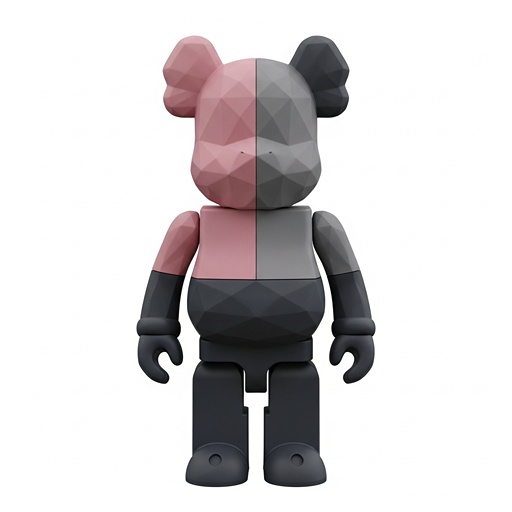
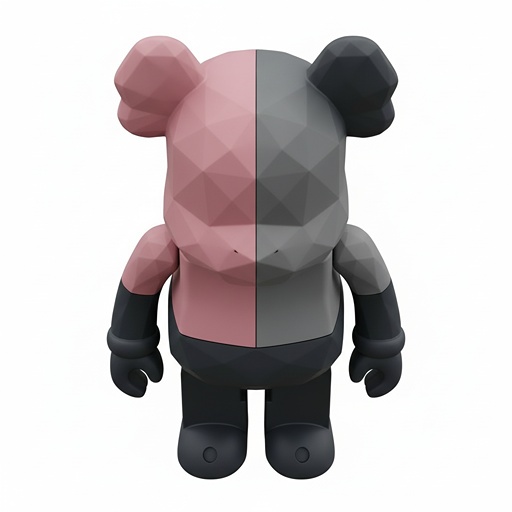
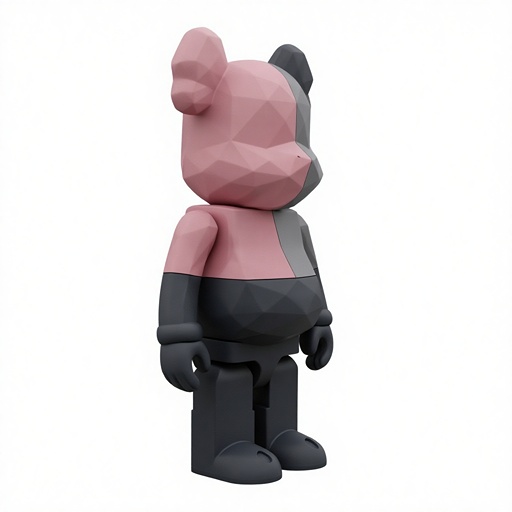
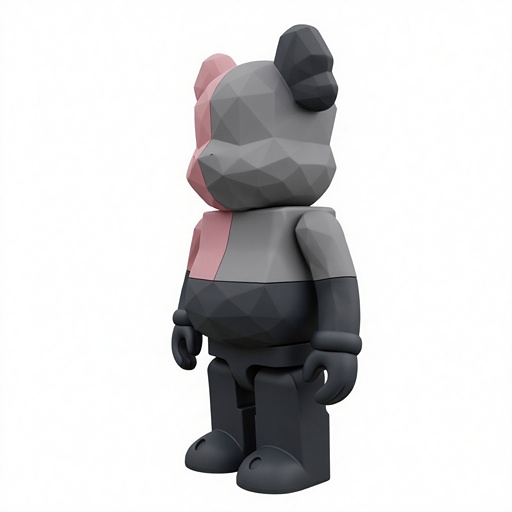
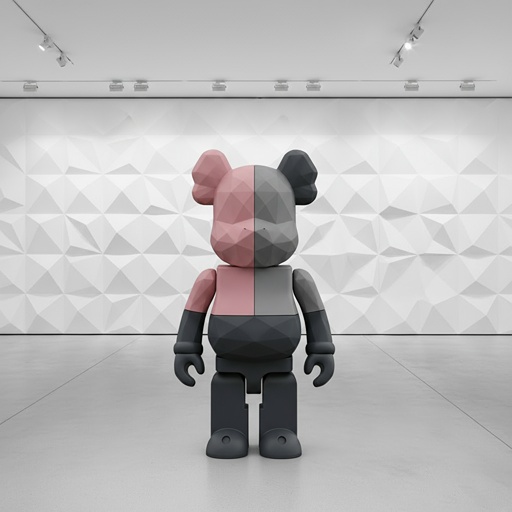
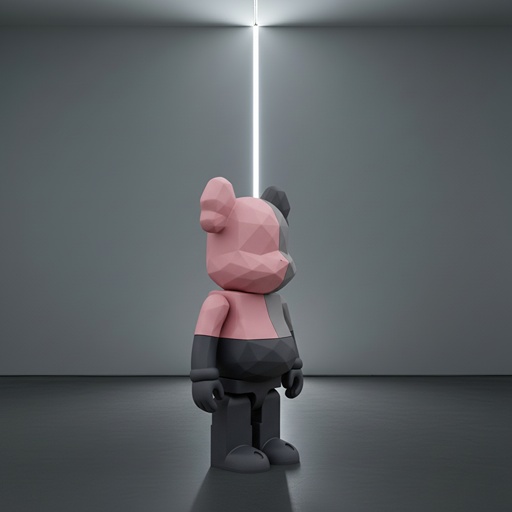
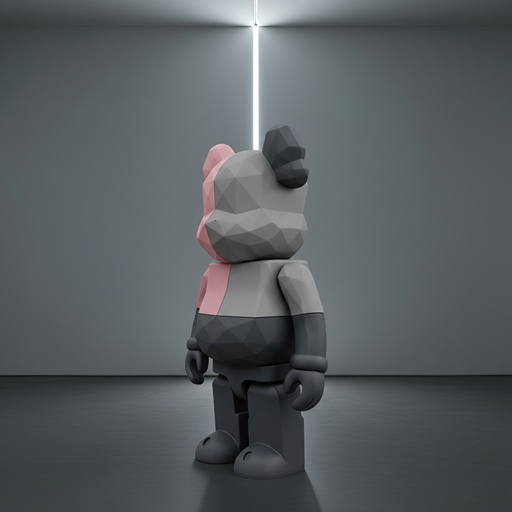
- Geometric Facets (Low Poly): AI abandoned the rounded curves of traditional art toys, instead using a "Low Poly" aesthetic. The toy's entire surface is composed of countless microscopic facets, allowing light to refract richly across it, enhancing its sculptural feel.
- Vertical Split (Down the middle): The most striking design language. AI uses a sharp central axis to vertically divide the toy in two ("solve the new riddle").
- Color Duality (The dark and the bright): The left side is given a soft "dusty pink" ("Pink on the toy"), while the right is a cool "charcoal grey." This juxtaposition of colors is not just visual color blocking, but a poetic expression of two opposing temperaments: "light and dark," "soft and hard."
|
|
|
|
Above: Multi-angle product views rendered by AI, accurately presenting the design essence of "geometric facets" and "vertical color blocking."
2. Two Worlds, One Space: Narrating in Light and Shadow
A "declaration of duality" requires an equally contrasting space to complete its narrative. AI constructed two opposing "worlds" for this art toy and had it pass between them ("Stepping 'cross the line"):
- The Bright (Clear White Gallery): The story begins in a bright, pure white art gallery with a complex geometric texture on the back wall. Here, the toy's silhouette is clearly illuminated, its colors and form on full display, representing its side as "truth" ("the style is the truth") publicly exhibited.
- The Dark (Divided Minimalist Room): Subsequently, it retreats into a minimalist dark room, the space vertically split by a sharp line of light ("Pink on the light") from the ceiling. This light hits the toy's central axis perfectly, leaving half of it in darkness ("Got the dark on the left") and half in light ("light on the right"), perfectly echoing its "Binary Harmony" design theme.
- Model's Intervention: AI further introduces a model in a denim jacket, who acts as a "manipulator" ("running this place"), using the toy as a connection point between the two worlds. He shuttles between the "daylight" of the outdoor architecture and the "night" of the neon-lit dark room, demonstrating the toy's powerful adaptability as an urban aesthetic symbol.
|

|
|
|
Above: AI-generated narrative scenes, where the art toy displays its "duality" in the opposing spaces of "bright" and "dark."
The concept film below, driven by a strong male rap beat and a signature split-screen montage, dynamically presents this "dark and the bright, two worlds one space" fashion statement.
3. Future Outlook: How to Inscribe This "Digital Contrapuntality"?
Q: For this 'Binary Harmony' art toy designed by AI, full of philosophical contemplation, how can RWA technology prove its creative value?
A: The core value of this art toy lies in its 'duality' design philosophy—this is an exquisite 'digital contrapuntality' creative executed by AI. It is not just a toy, but an artistic declaration constructed from code. Through Real World Asset (RWA) technology, we can mint an immutable 'Creative Source Point' for this 'digital contrapuntality' manuscript.
This 'Source Point' is a 'digital copyright certificate' anchored on the blockchain. It meticulously records all the key instructions that constitute this piece: from the 'low poly' geometric algorithm, to the precise color values for 'dusty pink' and 'charcoal grey,' to the sharp midline that defines its 'duality.'
This means that when this art toy is physically produced (becoming an RWA), its physical anchor (NFC chip) links not just to the product itself, but to the complete 'Binary Harmony' creative concept behind it. The owner receives not just a physical toy, but a verifiable 'voucher' proving they own the '1st edition' declaration that originated from the AI's initial creation. This endows AI's artistic creation with a traceable 'philosophical value,' transforming a design concept into a digital-physical asset that can be permanently collected and verified.